The Launch Day Illusion
As a product manager – you define the opportunity, validate the insight, align stakeholders, and ship with conviction. Somewhere in the back of your mind, you imagine the moment it all clicks. Adoption spikes. Momentum builds. Traction charts bend sharply upward.
That is the intoxicating promise of innovation. Before launch, innovation feels straightforward. You visualize a differentiated capability, a meaningful improvement over the status quo. You are introducing something new that creates value by solving a problem better, faster, or differently than before.
You’ve done the research, the testing, and the iteration. The roadmap makes sense, and the metrics look promising. Launch day becomes highly symbolic – the singular moment the market finally validates your belief.
And then it arrives.
You expect immediate adoption. What you get is… silence. A few signups trickle in. Some curious users poke around. Feedback is limited. You are nowhere near “mass adoption.”
That is the Launch Day Illusion.
The truth is that not everyone is waiting for your product. Not everyone sees the problem the same way you do, and not everyone is ready to try something new at the same time. Every launch teaches the same quiet lesson: shipping is not the finish line. It is only the beginning of a diffusion curve you do not control. Understanding that curve is where real product strategy begins.
The Innovation Myth: Why many large companies stumble.
Bigger organizations often fall into the trap of believing that innovation requires launching something massive: a major feature release, a flashy announcement, or a complex technology upgrade. There is immense pressure for the product to be perfect at launch, backed by aggressive forecasts, aligned across every function, and immediately impactful.
Real innovation rarely looks like that.
In reality, innovation is uncomfortable. It is iterative, uncertain, and often underwhelming in its early days. Real innovation starts small. It solves a narrow problem deeply rather than a broad problem superficially. It requires patience with low initial adoption and the willingness to learn from messy, contradictory feedback.
Large companies struggle because they optimize for predictability, revenue protection, and risk mitigation. Their systems are built to scale what already works, not to nurture what might work. Their decision frameworks demand definitive proof before experimentation. By the time consensus is achieved, the market opportunity has often already moved.
Startups, on the other hand, treat innovation differently. They don’t chase perfection; they chase learning. They launch fast, observe real behavior, and adapt quickly. They focus obsessively on a specific user problem and refine relentlessly until product-market fit emerges. Unburdened by legacy systems or internal politics, their iteration cycles are shorter and their conviction is sharper.
Innovation doesn’t belong to size. It belongs to mindset.
The Market View: The Innovator’s Dilemma
To understand how innovation turns into disruption, we must look at Clayton Christensen’s foundational concept: The Innovator’s Dilemma. This framework illustrates how established companies often see disruption coming but still cannot change course.
Let’s break down the dynamics within this diagram:
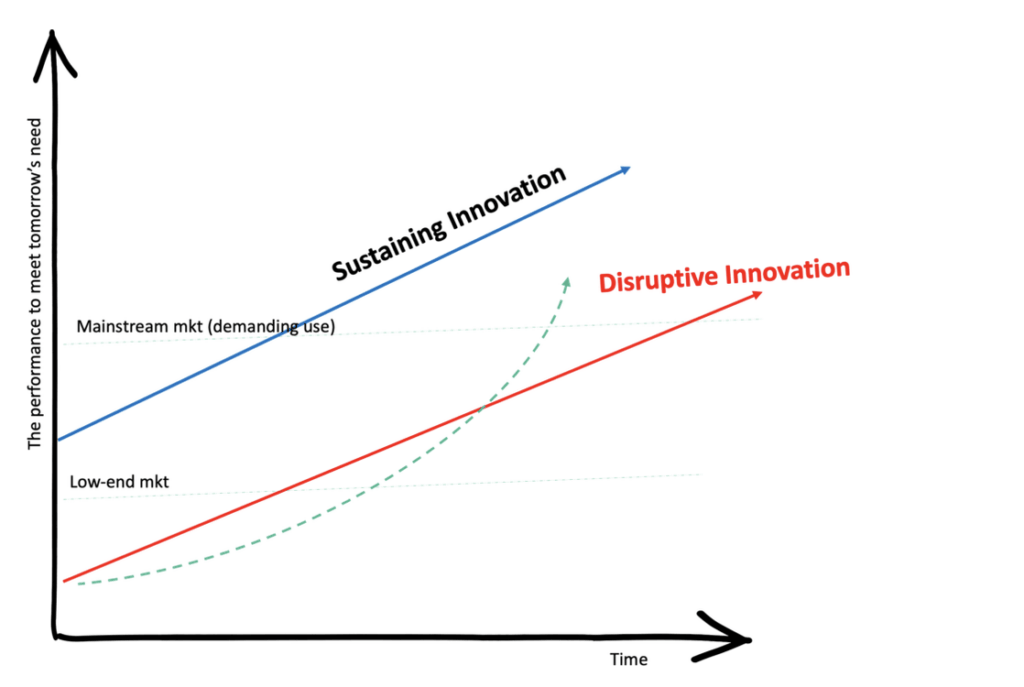
🔵 The Blue Line → Sustaining Innovation
This is what established companies excel at. They:
- Improve performance steadily on metrics mainstream customers care about.
- Target their best, highest-paying customers.
- Push toward the “high end” of the market.
This strategy looks incredibly smart in the short term, but it has a significant blind spot. The blue line often improves performance faster than mainstream customers actually need. This leads to overshooting, i.e. charging customers for performance they don’t utilize.
🔴 The Red Line → Disruptive Innovation
This is what new entrants (startups) do. They do not compete directly on performance. Instead, they start at the “bottom” of the market by offering solutions that are:
- Lower performance (initially).
- Cheaper.
- Simpler.
- Serving non-consumers or low-end users.
At first, mainstream customers reject them, accurately calling the products “inferior.” However, over time, the red line improves. Eventually, it reaches a critical point where it becomes “good enough” for mainstream customers while remaining much cheaper or more convenient.
That cross-over is the moment of disruption.
Where Disruptors Attack
Established companies fail not because they are poorly managed, but rather because they are well managed. They listen to their best customers, focus on high margins, improve performance continuously, and optimize for ROI. This success traps them in ‘Sustaining Innovation’. Meanwhile, startups target different segments:
1. 🟫 Non-Consumers (Bottom Left): People who couldn’t afford or access the existing complicated, expensive solution. (Example: SaaS vs. enterprise on-prem).
2. 🟨 Low-End Market: Customers who are overserved. They don’t need peak performance; they want lower cost, simplicity, and convenience. (Example: early personal computers vs. mainframes).
3. 🟩 Mainstream Market: This is where big companies dominate. When the disruptive line (red) crosses into this zone, incumbents start losing rapidly. By then, it is often too late to react.
The User View: How Consumers Adopt Innovation
When we say “consumers,” we often imagine one unified group. But adoption happens in distinct waves, and each wave behaves differently. Before we talk about disruption, we must understand who adopts innovation first.
Product Managers must understand this curve to survive the “silence” of launch day. Each group has a different definition of “good,” which shapes the product strategy you need to reach them.
1. Innovators (2.5%: The Experimenters)
These are the first people to try something new. They are risk-takers, tech enthusiasts, and experimenters comfortable with imperfection.
Innovators do not need social proof, case studies, or validation. They are motivated by access, novelty, status, and exploration.
Using the Jobs-To-Be-Done (JTBD) lens (which posits people don’t buy products, they “hire” them to get a job done), the job of an Innovator is often:
| “Help me explore, experiment, and stay ahead.”
2. Early Adopters (13.5%: The Opinion Leaders)
These users are visionaries, but more pragmatic than innovators. They are looking for strategic advantage, competitive positioning, and long-term value. If innovators validate possibility, early adopters validate viability.
3. Early Majority (34%: The Pragmatists)
This group are pragmatists. They need social proof and concrete results. They want what the early majority is using, but they will wait until the product is relatively polished and reliable. Disruption can only occur when this segment is won.
4. Late Majority (34%: The Skeptics)
This segment is skeptical and highly price-sensitive. They only adopt a technology when it has become an unavoidable standard.
5. Laggards (16%: The Traditionalists)
Traditional and resistant to change. They often only adopt new technology when older solutions are no longer available.
Strategy: Why Innovators Are Your Learning Engine
Innovators are not your early customers; they are your learning partners.
Because their definitions of success are different, what convinces them to try a product is also different. They are drawn to novelty, advanced features (like APIs), and community recognition. They actually tolerate bugs, missing documentation, and an imperfect UI because comfort is not their job. Exploration is.
How to Convince Innovators to Try Your Product
To innovators, innovation is exciting, and disruption is optional. Do not sell them reliability or mass validation. Sell them:
- Access to the future.
- A competitive edge.
- Direct influence over product direction
Invite them into the “lab.” Give them direct channels to your team, public recognition, and early access drops. They want to co-create, not just consume.
The Critical Insight → Innovators do not represent your market. They represent your learning engine.
If you misinterpret their early enthusiasm as mainstream market validation, you will misbuild for the majority. If you ignore them, you will never refine your innovation fast enough for the majority to eventually care.
Connecting the Dots
Product Managers must move beyond the blind spot that assumes launch = mainstream adoption.
Disruption is NOT a user motivation; it is a market outcome. It begins only when enough innovators experiment, enough early adopters validate, and the product becomes “good enough” in terms of performance, simplicity, and cost to appeal to the Early Majority.
Innovation begins as curiosity. Disruption begins as migration.
To bridge this gap successfully:
– You launch for innovators.
– You scale with early adopters.
– You win with the early majority.
The Airbnb Case Study
Let’s look at how Airbnb moved through these distinct stages, transforming from a “weird idea” into a total market shift:
Stage 1: The ‘Weird Idea’ for Innovators (2008–2010):
Initially, “sleeping in a stranger’s house” sounded absurd. The first to try were typical Innovators: budget travelers, conference attendees, and hosts willing to experiment. They tolerated poor UX, limited listings, and trust issues because Airbnb solved a specific job: “Help me find cheap, flexible lodging.”
Stage 2: Attracting Early Adopters Travel bloggers, digital nomads, and urban professionals saw a strategic advantage: unique experiences, better value, and flexible hosting income. At this stage, Airbnb was no longer just novel—it was viable.
Stage 3: Disruption and the Early Majority Disruption only occurred when reviews improved trust, payments became secure, and inventory expanded. Airbnb became “good enough” for mainstream travelers. Hotels didn’t lose because Airbnb was more luxurious; they lost because Airbnb served a job hotels rationally ignored: “Help me feel local, flexible, and cost-efficient.”
References:
“The Innovator’s Dilemma Book“ by Clayton Christensen
Comments