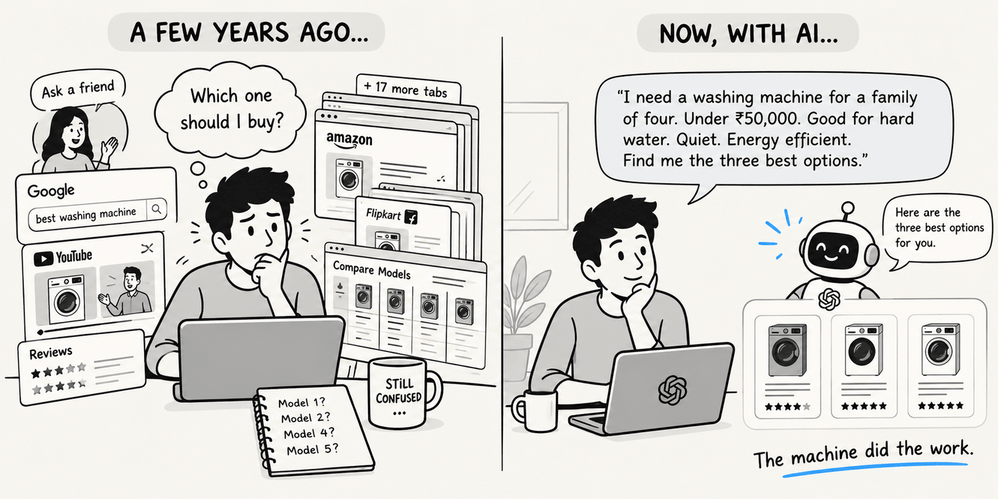
A few years ago, if you wanted to buy a washing machine, you probably did what humans have been doing forever. You asked a friend, and searched Google. You read some reviews, watched a YouTube video, visited Amazon. You compared five models. You got confused.
You opened another 17 tabs. And eventually, you bought the washing machine that felt right.
The advertising industry was built around this behavior:
Find the consumer. Understand the consumer. Show the consumer a relevant ad. Get the consumer to pay attention. Move them toward a decision.
It was a pretty good system.
Then AI showed up.
Now you can simply say:
“I need a washing machine for a family of four. Under ₹50,000. Good for hard water. Quiet. Energy efficient. Find me the three best options.”
And instead of spending an evening doing research, you get three options. The consumer didn’t search ten websites, didn’t see twenty ads, and didn’t compare 47 products.
The machine did.
And this creates a rather uncomfortable question for advertising:
What happens when the consumer stops doing the consideration work that AdTech has spent decades optimizing for?
The Ad Funnel Was Built for a Human Who Does the Searching
Most of modern AdTech is built around a relatively simple assumption → A human is navigating the marketplace.
So we optimize the journey.
Audience → Impression → Attention → Engagement → Consideration → Conversion
The more relevant the ad, the better the chance of capturing attention. The better the attention, the greater the chance of consideration. And the better the consideration, the greater the chance of conversion.
Hence the obsession with ad relevance.
• Who is this person?
• What are they interested in?
• What did they search for?
• What did they watch?
• What did they buy?
• What should we show them next?
We became extremely good at predicting what a person might want to see.
But AI is changing something more fundamental. It is increasingly helping decide what a person should consider.
That is a very different problem.
From Ad Relevance to Decision Relevance
Consider two scenarios.
Scenario 1: The old world
You search: “Best running shoes for marathon.”
You get ten links. You click around and see Nike. Then Adidas. Asics. Hoka. Then another shoe brand you’ve never heard of. And somewhere in between, an ad follows you around for the next two weeks reminding you that you once searched for running shoes.
This is ad relevance.
The system knows you are interested in running shoes.So it tries to put a relevant message in front of you.
Scenario 2: The AI world
You tell an AI:
“I’m training for my first marathon. I overpronate, run about 40 km a week and want to spend less than ₹15,000. Which shoes should I buy?”
Now the problem isn’t:
“Which running shoe ad should this person see?”
The problem is:
“Which running shoes should this person consider?”
The machine needs to reason across products, attributes, reviews, prices, availability, preferences and trade-offs. The brand doesn’t merely need to be relevant to the consumer.
It needs to be relevant to the decision.
That is the shift:
Ad Relevance → Decision Relevance
And it changes the advertising funnel.
The Invisible Change: The Consumer Is Delegating Work
The biggest impact of AI on consumer behavior may not actually be the chatbot.
It is delegation.
We are beginning to delegate pieces of our decision-making to machines.
We delegate research: “Research the best laptops for me.”
We delegate comparison: “Compare these insurance policies.”
We delegate discovery: “Find me a restaurant for a team dinner.”
We delegate planning: “Plan my three-day trip to Tokyo.”
We delegate shopping: “Find me a black formal shoe under ₹10,000.”
And eventually, increasingly, we delegate execution: “Buy the best one.”
This matters enormously for advertising. Because advertising has traditionally benefited from the work consumers do while making decisions.
Every search is an opportunity. Every comparison is an opportunity. Every website visit is an opportunity. Every product page is an opportunity. Every content interaction is an opportunity. Every consideration set is an opportunity.
But what happens when AI compresses 30 minutes of consumer research into 30 seconds?
Many of those opportunities disappear from the human-facing funnel.
The consumer isn’t necessarily seeing fewer brands because they are less interested. They are seeing fewer brands because the machine filtered them before they arrived.
The New Gatekeeper Doesn’t Have Eyes
And this brings us to what I think is one of the most important concepts for advertising in an AI world: Machine Legibility
Humans can understand brands through incredibly messy signals. We see an ad and infer quality. We watch a movie and develop an emotional association. We hear someone recommend a product and trust it. We recognize a logo. We remember a brand from childhood. We see a beautifully designed website and think, “These guys probably know what they’re doing.”
Humans are excellent at filling in the gaps.
Machines are different.
An AI agent needs to understand what something is, what it does, who it is for, how it compares, whether its claims are credible, whether it is available, and whether it satisfies the user’s specific constraints. The machine cannot simply “feel” that your brand is premium.
It needs signals from which premium can be inferred.
This is why machine legibility matters. Your brand needs to be understandable not only to people, but increasingly to the systems helping people make decisions.
Why Machine Legibility Matters Now
This isn’t about some distant future where AI agents take over shopping. Consumer behavior is already moving toward fewer direct interactions and more mediated interactions.
Think about how quickly interfaces have changed. We went from:
Store → Website → Search → App → Feed → Recommendation → AI
Each transition reduced the amount of work the consumer had to do. The store gave us aisles. Search engines gave us ranked results. Amazon gave us recommendations. Social feeds gave us algorithmic discovery.
AI agents are taking the next step: They can make sense of the marketplace for us. And every time we move one step further toward delegation, the importance of machine interpretation increases.
Example 1: Travel
The old journey:
Search “best hotels in London.” Then: Google. Booking site. Travel blog. YouTube. Reviews. Maps. Hotel websites. Comparison. More reviews. Then finally booking. A huge number of advertising and discovery opportunities exist along that journey.
Now imagine:
“I have meetings in Seattle Tuesday and Wednesday. Find me a hotel within 20 minutes, under $250 a night, with good business reviews, breakfast, free cancellation and a gym.”
The AI can potentially collapse the entire research journey into a shortlist.
Now ask:
Which hotels make it into the shortlist?
That is not primarily an advertising question. It is a machine consideration question.
Example 2: Commerce
The same thing happens in commerce.
Today:
Search → Browse → Filter → Compare → Read reviews → Add to cart.
Tomorrow:
“I need a monitor for my home office. 32-inch, 4K, USB-C, good for spreadsheets and occasional gaming. Under ₹40,000.”
The machine can perform the filtering. This means product information becomes advertising infrastructure. Specifications become discoverability infrastructure. Reviews become trust infrastructure. Availability becomes recommendation infrastructure. Pricing becomes decision infrastructure.
The line between commerce data and advertising data starts to blur.
Example 3: Financial Services
Insurance is an even more obvious example. Most consumers don’t really want to “shop for insurance.” They want to solve a problem:
“I need health insurance for my family. ₹20 lakh coverage. Low waiting periods. Good hospital network. Compare the best options.”
The AI doesn’t need to show them 15 insurance ads. It needs to determine which policies satisfy the requirements. Suddenly, the winning brand isn’t necessarily the one with the cleverest campaign. It may be the one whose product, reputation, coverage, pricing and terms are easiest for the machine to understand and defend.
Ad relevance → Decision relevance.
This Is Where Ad Utility Enters
So if AI is reducing the number of traditional advertising touchpoints, what should advertising become?
My answer is: More useful.
For a long time, advertising has primarily been about communication. Here is our message. Here is our brand. Here is why you should choose us.
AI creates an opportunity to make advertising part of the decision itself.
Instead of: “Here is an ad for a laptop.” Think: “Here are three laptops that meet your requirements. Here’s how they differ.”
Instead of: “Here is an ad for a hotel.” Think: “Here are the three hotels closest to your meeting, ranked by commute time, cancellation flexibility and reviews.”
Instead of: “Here is an insurance ad.” Think: “Here are the policies that meet your coverage requirements, with the important differences highlighted.”
The ad stops being merely a message delivered to a consumer. It becomes a service delivered to a decision. That is Ad Utility.
The New Unit of Advertising
For decades, the fundamental unit of digital advertising has been the impression.
Then we started caring about clicks. Then conversions. Then attention.
AI could push us toward another unit: Utility.
Did the advertising help the consumer? Did it reduce search effort? Did it simplify comparison? Did it answer a question? Did it narrow the choice set? Did it improve the decision? Did it remove uncertainty? Did it accelerate the transaction?
This doesn’t mean impressions disappear. It means the value of an impression may increasingly depend on what it helps the consumer do.
The Interesting Paradox
There is an interesting paradox here: the better AI becomes at helping consumers make decisions, the less advertising consumers may need to consciously consume.
That sounds terrible for advertising.
I actually think it could be the opposite. It means advertising has an opportunity to become more valuable.
Because instead of interrupting a decision, it can participate in one. Instead of asking for attention, it can earn attention through usefulness.
Instead of saying: “Look at me.”
Advertising can say: “I’ll help you decide.”
That is a much stronger proposition.
What Should Brands Do?
If machine legibility and ad utility are becoming important, brands should start thinking about a few things differently.
1. Make your brand machine-legible
Don’t assume AI systems will infer what humans infer. Make your products, services, claims, attributes, pricing, availability and differentiators clear and consistent.
The question isn’t only: “Can a consumer understand us?”
It increasingly becomes: “Can a machine accurately represent us?”
2. Optimize for decisions, not just audiences
Traditional segmentation asks: Who is the customer?
AI-native marketing needs to additionally ask: What decisions does this customer make, and what information helps them make those decisions?
That moves the conversation from audiences to intent and context.
3. Turn advertising into utility
Don’t just communicate a product. Help someone evaluate it. Build comparison tools. Answer questions. Surface relevant products. Explain trade-offs. Personalize recommendations. Reduce uncertainty. Make the next decision easier.
The best ad may increasingly be the one that does something useful.
4. Build for both audiences
Your audience is no longer just the consumer. There is a second interpreter between your brand and the consumer. The machine.
So ask two questions: Would a human want this? And: Would a machine understand this?
The first creates preference. The second creates discoverability.
5. Measure machine consideration
We have spent years developing metrics for human attention.
• Viewability.
• Completion.
• Attentive seconds.
• Engagement.
• Brand lift.
• Conversion.
We may eventually need an equivalent measurement system for machine attention:
• Can machines discover the brand?
• Can they accurately describe it?
• Does it appear in relevant recommendations?
• How often is it considered?
• How does it rank against alternatives?
• Does the machine’s representation of the brand match the brand’s intended positioning?
We don’t yet have a universally accepted answer to all of these. But the questions are coming.
The Future Isn’t Human vs. Machine
I don’t think the future of advertising is about choosing between human attention and machine attention. It is about understanding the relationship between them.
Machines increasingly decide what deserves human attention.
And humans still decide what deserves human preference. That creates a new advertising equation:
Machine Legibility → Machine Consideration → Human Attention → Human Preference → Action
And somewhere in the middle sits Ad Utility. Because if advertising is going to survive a world where machines increasingly mediate discovery, the answer may not be to fight harder for attention. It may be to become more useful.
The question advertising has historically asked is:
“How do I get the consumer to notice me?”
The next question may be:
“How do I get the machine to consider me?”
But the more interesting question is:
“How can I help both the machine and the human make a better decision?”
That is where AdTech moves from relevance to utility. And perhaps advertising’s next attention problem isn’t really about getting more attention at all.
It’s about becoming useful enough to deserve it.
Comments