The human mind is not a perfectly rational decision engine. Products succeed when they understand the shortcuts, emotions, and inconsistencies that shape how people actually behave.
We like to believe that consumers see a product, evaluate its features, compare alternatives, and make a rational decision.
They don’t.
A shopper chooses the more expensive option because it feels safer. A user keeps paying for a subscription they barely use because cancelling feels like admitting a mistake. Someone clicks a notification because it creates urgency, even when they know the offer will probably still be there tomorrow.
These aren’t random behaviors. They are often systematic.
Imagine walking into a supermarket where the most expensive wine is placed first, the “most popular” product is highlighted in the middle, and a sign warns you that your favorite item is almost out of stock. Nothing has changed about the products themselves, but suddenly, your perception has. The first price anchors your judgment, popularity becomes social proof, and scarcity creates urgency. Three small cues, three powerful biases, quietly shaping the same decision. The shelf hasn’t made the decision for you; it has changed how you make it. That is the power of human biases, and why understanding them matters in product design.
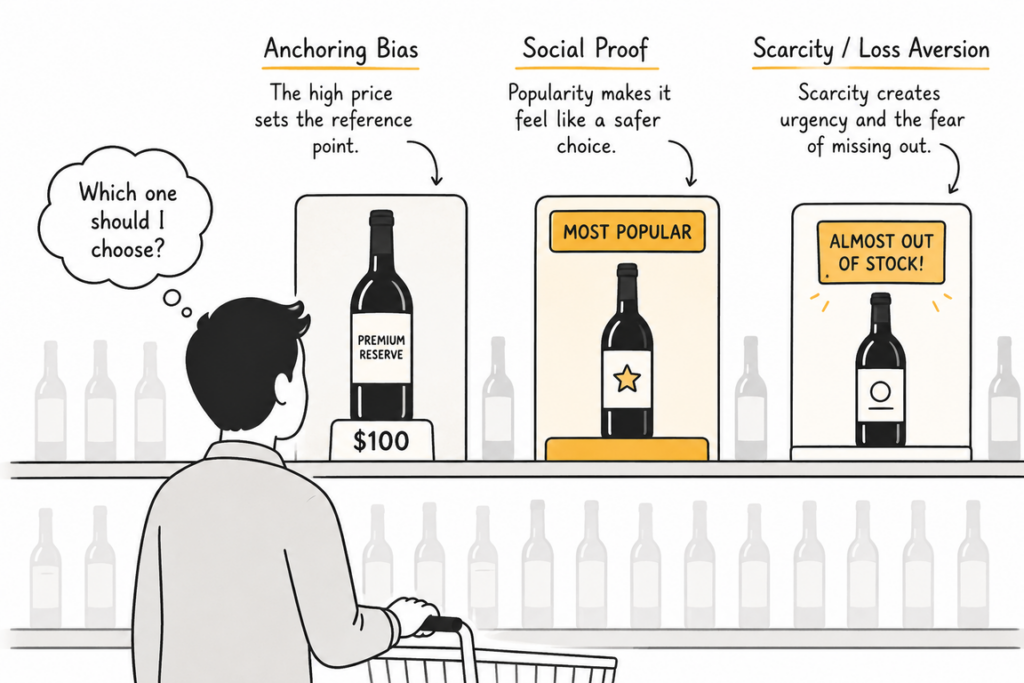
Human behavior is shaped by mental shortcuts, imperfect memory, emotions, context, and the way choices are presented. These forces create predictable deviations from what traditional economic models would call “rational” behavior.
For product builders, this matters enormously. Because products don’t just solve functional problems. They interact with human psychology.
Two kinds of bias
A useful starting point is to separate behavioral biases into two broad categories:
Cognitive biases arise from the way we process information. They are often shortcuts our brain uses to make decisions quickly, especially when information is complex, uncertain, or overwhelming.
Emotional biases arise from feelings, impulses, and emotional states. They influence decisions even when we intellectually understand that a different choice may be more rational.
The distinction isn’t always perfect. Many real-world biases have both cognitive and emotional components. But it provides a useful lens for product development:
Cognitive biases influence how people interpret choices. Emotional biases influence how they feel about those choices.
And both influence what they ultimately do.
Cognitive Biases
1. Anchoring Bias:
People tend to rely heavily on the first piece of information they encounter when making subsequent judgments. A product originally priced at $1,000 suddenly looks attractive at $700 because the consumer’s reference point has already been established.
In product design
Anchors can shape how users perceive:
– Price
– Performance
– Quality
– Value
– Time
– Size
– Features
This is why showing a premium plan first can make the middle-tier plan feel more reasonable. Or why displaying the “original price” next to a discounted price changes perceived value.
The interesting part isn’t the number itself. It’s the reference point the number creates.
Product implication
When designing a pricing page, comparison experience, or recommendation system, ask:
What is the user comparing this against?
Sometimes the product isn’t changing the value proposition. It’s changing the frame through which value is perceived.
2. Availability Heuristic:
People tend to judge the likelihood or importance of something based on how easily examples come to mind. If you recently saw several stories about airplane crashes, flying may suddenly feel more dangerous, even though the underlying probability hasn’t changed.
In product design
Users don’t evaluate every possibility mathematically. They rely on what is salient and memorable. Reviews, trending products, recent searches, notifications, headlines, and recommendations all influence what comes to mind. This has major implications for recommendation products.
If a product repeatedly surfaces a certain type of content, that content becomes disproportionately present in the user’s mental model of what matters.
Product implication
Recommendation systems aren’t merely deciding what users see. They’re also influencing what users think exists. That makes ranking and recommendation a psychological design problem—not just an algorithmic one.
3. Confirmation Bias:
People tend to seek, interpret, and remember information that confirms what they already believe. A user who believes a product is bad may notice every negative review while discounting positive ones.
In product design
This bias doesn’t just affect consumers. Product teams suffer from it too.A PM who believes a feature will succeed can unconsciously:
– prioritize supporting evidence
– dismiss contradictory research
– interpret ambiguous data favorably
– select favorable customer quotes
– rationalize disappointing metrics
Product implication
Good product development therefore requires mechanisms that fight our own biases.
Examples include:
– Post-launch reviews
– Blind experiments
– Pre-defined success metrics
– A/B testing
– Counter-hypotheses
– Customer research
The goal isn’t to eliminate judgment. It’s to create systems where judgment can be challenged by evidence.
4. Loss Aversion:
People generally experience the pain of losing something more strongly than the pleasure of gaining something of equivalent value. Losing $100 doesn’t feel psychologically equivalent to gaining $100.
In product design
Loss aversion appears everywhere:
• “Don’t lose your rewards.”
• “Your saved items expire soon.”
• “You’ll lose access to these features.”
• “Your streak is about to end.”
It also explains why users can resist product changes even when the new experience is objectively better. Users aren’t comparing – Old product vs. new product.
They may instead be experiencing – What I have vs. what I’m about to lose.
Product implication
When migrating users to a new experience, product teams should explicitly identify perceived losses, not just communicate new benefits. A feature migration can fail not because users dislike the new product, but because they feel they’re losing control, familiarity, history, or status.
5. Status Quo Bias:
People tend to prefer the existing state of affairs over changing to an alternative. The current option becomes the default.
In product design
Defaults are extraordinarily powerful.
Consider:
• Default privacy settings
• Default payment methods
• Default recommendations
• Default subscription tiers
• Default notification settings
• Default shipping options
Users often don’t actively choose the default. They simply don’t change it.This means product teams have enormous responsibility when defining defaults.
Product implication
A default isn’t neutral. A default is a product decision about what happens when the user doesn’t decide.That makes default design one of the most consequential, and often overlooked parts of UX.
6. Choice Overload:
More choices don’t always create more value. Beyond a point, additional options can increase cognitive load and make decisions harder. A restaurant menu with 10 dishes may feel easier than one with 100.
In products
Choice overload appears in:
• Configuration-heavy products
• Streaming catalogs
• E-commerce
• SaaS plans
• Search results
• Recommendation feeds
More inventory can theoretically improve relevance. But more inventory also increases the cost of choosing.
Product implication
The product challenge isn’t always:
“How do we give users more choices?”
It can be:
“How do we make the right choice easier?”
Personalization, ranking, filtering, recommendations, and intelligent defaults are essentially mechanisms for reducing the cognitive cost of choice.
7. Hindsight Bias:
Hindsight bias is our tendency to look at an outcome after it has happened and feel that it was obvious or predictable all along. Once we know the answer, the uncertainty that existed beforehand tends to disappear from our memory.
In product design:
This is especially dangerous in retrospectives. A product launches successfully, and suddenly the winning strategy looks inevitable. A feature fails, and the warning signs appear obvious in retrospect. But decisions are made with the information available at that point in time, not with the benefit of hindsight. This can lead teams to unfairly judge past decisions, overlook genuine uncertainty, and create false confidence in their ability to predict future outcomes.
Product implication:
Separate decision quality from outcome quality. A good decision can produce a bad outcome, and a bad decision can sometimes get lucky. Recording hypotheses, assumptions, and expected outcomes before a launch or experiment helps teams evaluate decisions based on what they actually knew at the time.
8. Fundamental Attribution Error:
We tend to explain other people’s behavior through their personality or ability, while explaining our own behavior through circumstances.
A teammate misses a deadline:
“They aren’t organized.”
We miss a deadline:
“There were too many dependencies.”
In product dsign:
The same bias can distort how we interpret customer behavior. A user abandons onboarding and we may conclude, “They’re not engaged.” But the real reason could be a confusing interface, poor connectivity, an unexpected requirement, or simply bad timing. It can also influence how product teams perceive partners, engineering teams, customers, or competitors, turning systemic problems into judgments about individuals or groups.
Product implication:
Before attributing behavior to who someone is, examine what situation they were in (apply JTBD here). When a customer doesn’t behave as expected, ask:
What did the product, context, or environment make difficult?
Good product design often starts by fixing the environment rather than blaming the user.
9. Dunning-Kruger Effect:
The Dunning-Kruger effect describes how people with limited knowledge or skill in an area can overestimate their competence. Ironically, knowing enough to recognize complexity is often what makes someone more aware of what they don’t know.
In product design:
This can show up when teams make strong conclusions from limited evidence. Someone who has seen a few customer interviews may feel they understand the customer. Someone who has worked on one part of an ad stack may assume they understand the entire system.
The problem isn’t confidence itself. It’s confidence without sufficient calibration. This becomes particularly risky in ambiguous product problems, where the system has many interacting variables and the available data is incomplete.
Product implication:
Build mechanisms that reward curiosity over certainty. Encourage teams to articulate:
• What do we know?
• What do we think we know?
• What are we assuming?
• What would change our mind?
• What don’t we understand yet?
The most effective product thinkers aren’t necessarily the ones with the fastest answers. They’re often the ones who know which questions they haven’t answered yet.
Emotional Biases
Cognitive biases affect how we process information. Emotional biases are different. Sometimes we know what the rational choice is, and still don’t make it. Because we feel something.
1. Fear of Missing Out (FOMO)
People experience anxiety that others are benefiting from an opportunity they are missing. FOMO turns an ordinary opportunity into a time-sensitive one.
In products
It appears through:
• “Only 2 left”
• “23 people are viewing this”
• Trending indicators
• Limited-time offers
• Expiring rewards
• Social activity
• Live counters
The underlying product mechanism is simple: Turn a choice into a potential loss.
Product implication
FOMO can dramatically increase conversion.But it can also damage trust if the urgency is manufactured. The best product design therefore uses urgency when it reflects a real constraint, rather than fabricating scarcity.
2. Endowment Effect
People tend to value something more once they perceive it as theirs. This is why free trials can be powerful.
Before the trial:
“Do I need this?”
After the trial:
“Why are you taking this away?”
The product hasn’t necessarily become more valuable. Ownership has changed the perception of value.
Product implication
Products can create perceived ownership through:
• Personalization
• Saved content
• Playlists
• Profiles
• History
• Collections
• Progress
• Custom configurations
The more users build into a product, the more psychologically expensive it can become to leave. This can drive retention, but again, there’s an ethical distinction between creating genuine switching value and deliberately creating lock-in.
3. Sunk Cost Fallacy:
People continue investing in something because they’ve already invested heavily in it, even when abandoning it would be rational. “I’ve already spent so much time on this.”
In products
Users may continue:
• Completing a difficult onboarding process
• Playing a game
• Maintaining a streak
• Using a complicated tool
• Watching a long series
• Building a collection
because abandoning it would make previous effort feel wasted.
Product implication
Progress indicators can therefore be powerful. A user who is 80% through a process is psychologically different from someone who is 0% through it. But this creates a design responsibility:
Are we helping users realize the value of their investment, or using their investment to keep them trapped?
4. Social Proof:
When uncertain, people look at what others are doing to determine what is appropriate or valuable. Humans are social decision-makers.
In product design
Social proof appears as:
• Ratings
• Reviews
• “Most popular”
• Number of users
• Creator counts
• Purchases
• Likes
• Testimonials
• “Recommended by…”
A product becomes easier to choose when someone else has already chosen it.
Product implication
Social proof is particularly powerful when product quality is difficult to evaluate before consumption.
This is why reviews are so important in marketplaces. The user isn’t just asking:
“Is this product good?”
They’re asking:
“What did people like me think about it?”
The Product Designer’s Bias
The most interesting insight is that biases aren’t merely consumer problems. They are also product inputs.
A product designer has to reason about three different things:
(i) What users say.
(ii) What users think.
(iii) What users actually do.
And these can be very different. A user might say they want more choices. Their behavior might show that they consistently choose from the first five recommendations. They might say they care about price. Their purchases might reveal that reviews, brand familiarity, or convenience matter more. This is where behavioral data becomes powerful.
From Biases to Product Signals
Behavioral data gives us a window into biases that users may never articulate. Consider a simple sequence:
Exposure → Choice → Behavior → Outcome
A product can observe:
– What was shown
– What was clicked
– What was ignored
– What was purchased
– How long someone engaged
– Whether they returned
– Where they abandoned
Patterns across these behaviors reveal underlying preferences and biases. But there’s an important distinction:
A behavioral signal is not automatically a behavioral truth.
A user clicking something doesn’t necessarily mean they liked it. A user abandoning a flow doesn’t necessarily mean they disliked the product. A user choosing the default doesn’t necessarily mean they preferred it. Context matters. The product challenge is therefore to move from
Data → Pattern → Hypothesis → Experiment → Insight
Why This Matters in Product Development
Understanding bias changes how we build products at every stage.
1. Discovery:
Instead of asking only:
“What do customers want?”
we can ask:
“What are customers actually doing, and what psychological forces might explain it?”
2. Design:
Instead of designing the theoretically optimal choice architecture, we design for the way humans actually make decisions.
3. Prioritization:
Behavioral evidence can reveal which problems are truly consequential versus those customers merely articulate.
4. Experimentation
Biases give us hypotheses to test. Does a default increase adoption? Does social proof increase conversion? Does reducing choices improve completion? Does urgency increase short-term conversion but hurt long-term trust?
5. Metrics
The right metric isn’t always immediate conversion. A design exploiting loss aversion might increase clicks while reducing satisfaction. A recommendation system might increase engagement while narrowing discovery. A product needs to optimize for customer value, not merely behavioral response.
The Ethical Line
This is where behavioral product design becomes particularly interesting. Every bias can be used in two ways.
To help the user make a better decision.
Or:
To make the user do something the product wants.
Those are not the same thing.
A default can save users time. Or quietly push them into something they wouldn’t choose.
Social proof can reduce uncertainty. Or manufacture popularity.
Loss aversion can communicate a genuine consequence. Or create artificial fear.
Personalization can reduce choice overload. Or exploit what the system knows about a user’s vulnerabilities.
The difference isn’t the psychological mechanism. It’s the intent and the value exchange behind it.
The Fundamental Question
The best product teams don’t ask:
“Which bias can we exploit?”
They ask:
“Which human tendency can we design around?”
That distinction matters. Because the goal of behavioral product design isn’t to outsmart the user. It’s to understand the user well enough to build products that feel more intuitive, more useful, and more aligned with how humans actually think and behave.
And perhaps that’s the real opportunity in behavioral data:
Not predicting what people will click. Understanding why they click. That why is where product design becomes science.
Comments